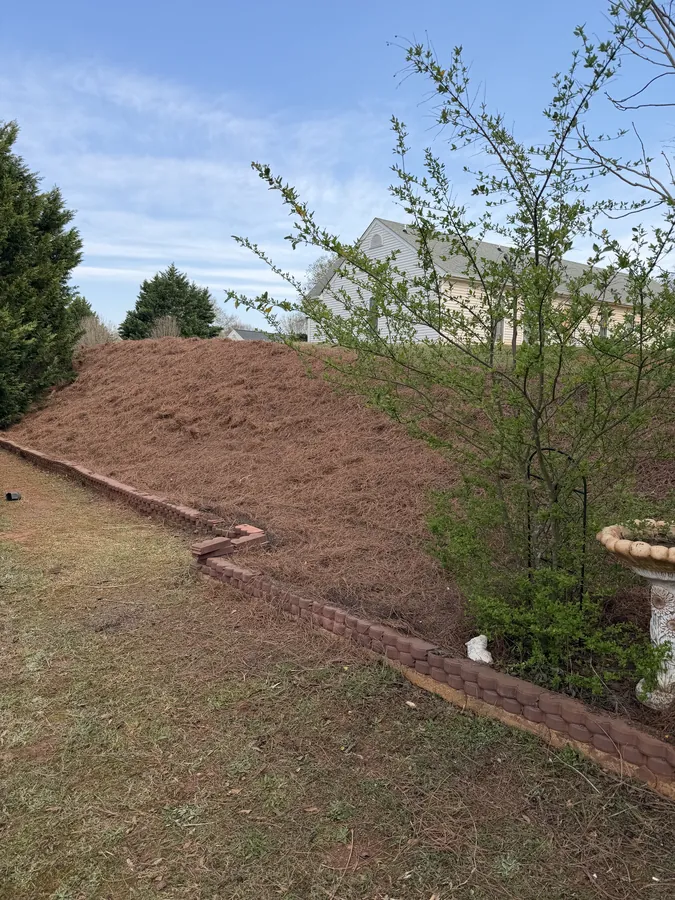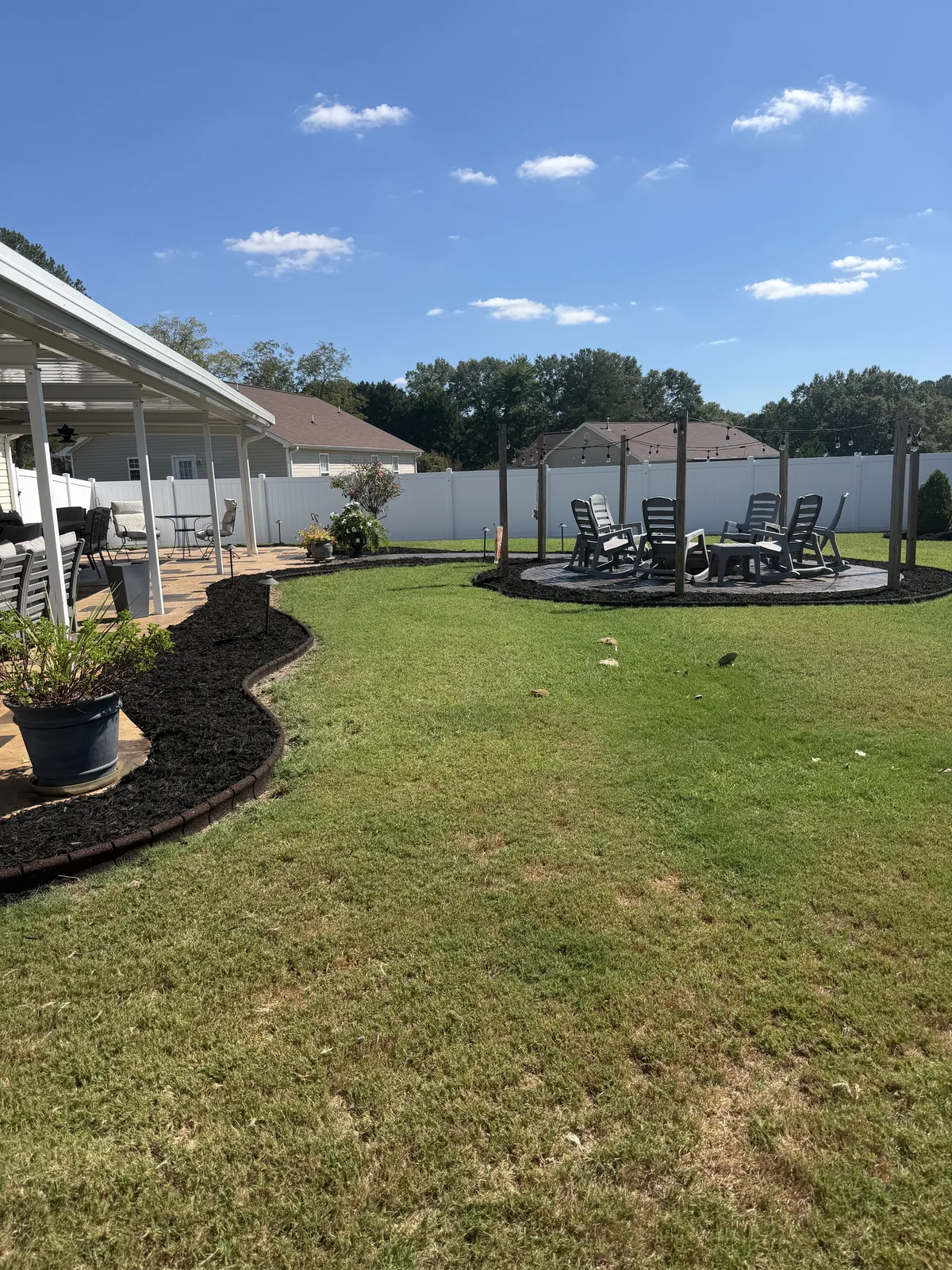
Black mulch, pine straw or river rock, spread at the right depth, kept off the trunks and finished with a clean edge.
Get a free estimateTell us your number and we will call you back.
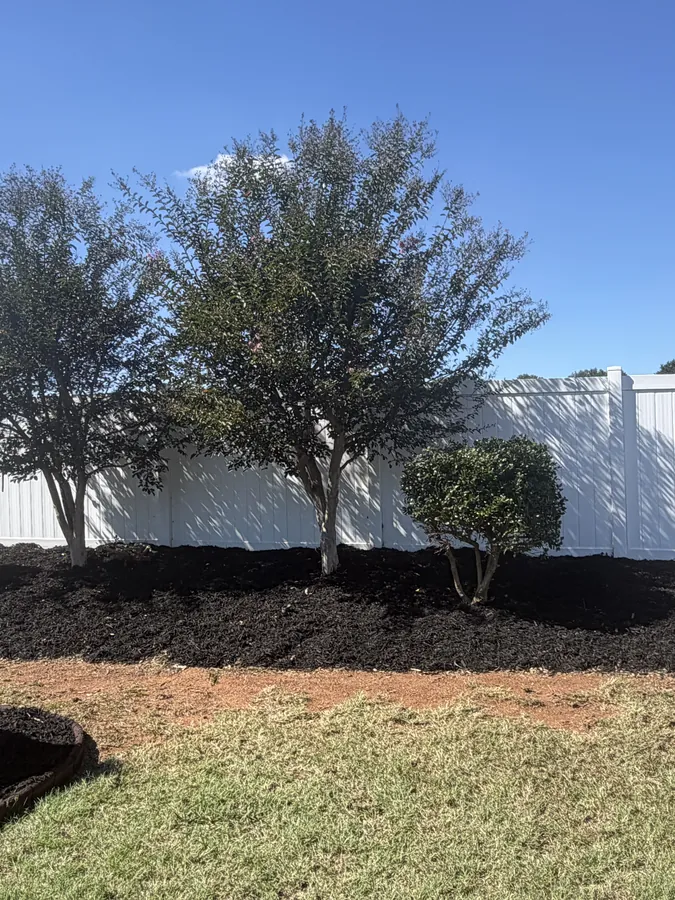
Mulch earns its place in a bed. Clemson Extension's Carolina Yards program recommends a two to three inch layer in plant beds and around trees and shrubs, and notes that it cuts down erosion and holds back weeds. Clemson's mulch guide sets the limits: fine wood and bark mulch no deeper than 2 to 3 inches, and coarse pine bark nuggets up to 4. It also warns that too much fine mulch can harm roots. So before a fresh layer goes down, we check how much is already in the bed and only add what it needs.
Mulch has to stay off the plants, too. Clemson says to keep it 2 to 3 inches away from the stems of woody plants and never to pile it against a tree trunk, so we pull old mulch back before the new layer goes on. On a slope, pine straw is often the smarter pick. Clemson's mulch guide says pine needles interlock and stay in place better than most mulches on a slope, and its water guide says 2 to 3 inches of cover protects the soil and reduces erosion. Pine straw and bark both last about two to four years.
River rock is the third option, and it suits some spots better than others. Clemson's mulch guide calls gravel and stone permanent, a good match for foundation plantings, and says they rarely need topping off. It also warns that stone reflects the sun, can make a bed very hot in summer, and should be avoided around acid-loving plants. That is why we lay rock along walkways, foundations and carport edges, and keep wood mulch or pine straw in the beds where shrubs need cooler ground. Every bed gets a clean edge cut into the lawn.
Each one has a job. Wood mulch gives a dark, finished look and breaks down into the soil over time. Pine straw stays put on a slope better than most mulches, according to Clemson Extension. River rock is close to permanent but holds heat in summer and is a poor match for acid-loving plants. A yard can use rock along a walk and mulch in the planting beds.
Clemson's mulch guide says pine straw and bark typically last two to four years before more is needed, though some homeowners like a fresh layer for color sooner. Before adding any, we check the depth. If two to three inches are still there, a light refresh is all the bed needs, not another full layer.
Clemson Extension says to keep mulch 2 to 3 inches away from the stems of woody plants and not to pile it against trunks, and its shrub planting guide gives the reason: mulch against the stem can lead to stem rot. We pull old mulch back from trunks and stems before the fresh layer goes down.
It depends on the size of the yard and what it needs, so we come out and give you a straight quote first. Our customers call our prices competitive and affordable.
Ralph. Customers call him hardworking and a genuinely nice guy, and he's easy to reach whenever you need something.
Anderson and the towns around it: Centerville, Homeland Park, Pendleton, Clemson, Townville, Powdersville, Williamston, Belton, Starr and Iva. Not sure if you're in range? Just give us a call at (864) 540-5167.
Your call. We haul it away, or we mulch it back into the yard, whichever you prefer. Just tell us when we set up the job.
All three. We spread dark mulch, lay pine straw on slopes and around trees, and build river rock beds along walkways and under carports. You can see each of them in our photos.
Yes. We till the bed, dig the holes and set the plants in, right down to your flowers. Tell us what you have when you call and we will plan where it all goes.